
How Weft Hair Extensions Are Installed: Beaded, Hand-Tied & Sew-In (2026)
Weft extensions are installed on a beaded foundation row — no glue, heat, or chemicals. A stylist who oversees weft installs daily explains each method step by step, what installs cost per row ($105 beaded, $165 hand-tied), how move-ups work, and the honest answer on DIY weft installation.
By Crystal Frehner, Hottie Hair co-founder. "How do you install weft hair extensions?" is one of the most-searched extension questions on the internet — and most of the answers are either brand marketing or DIY videos that make experienced stylists wince. Here's the real answer from a salon that installs wefts every single day: how each weft method actually goes in, what the differences are, what it costs, and the honest truth about installing wefts yourself.
Weft hair extensions are installed by creating a secure foundation row on your natural hair — a track of small silicone-lined beads — and attaching the weft (a curtain of hair sewn or machine-bonded at the top) to that row. No glue, no heat, no chemicals touch your hair. The three main variations — beaded weft, hand-tied weft, and traditional sew-in — differ in the weft itself and how it's secured, and a professional install takes roughly 45 minutes to 3+ hours depending on how many rows you're getting.

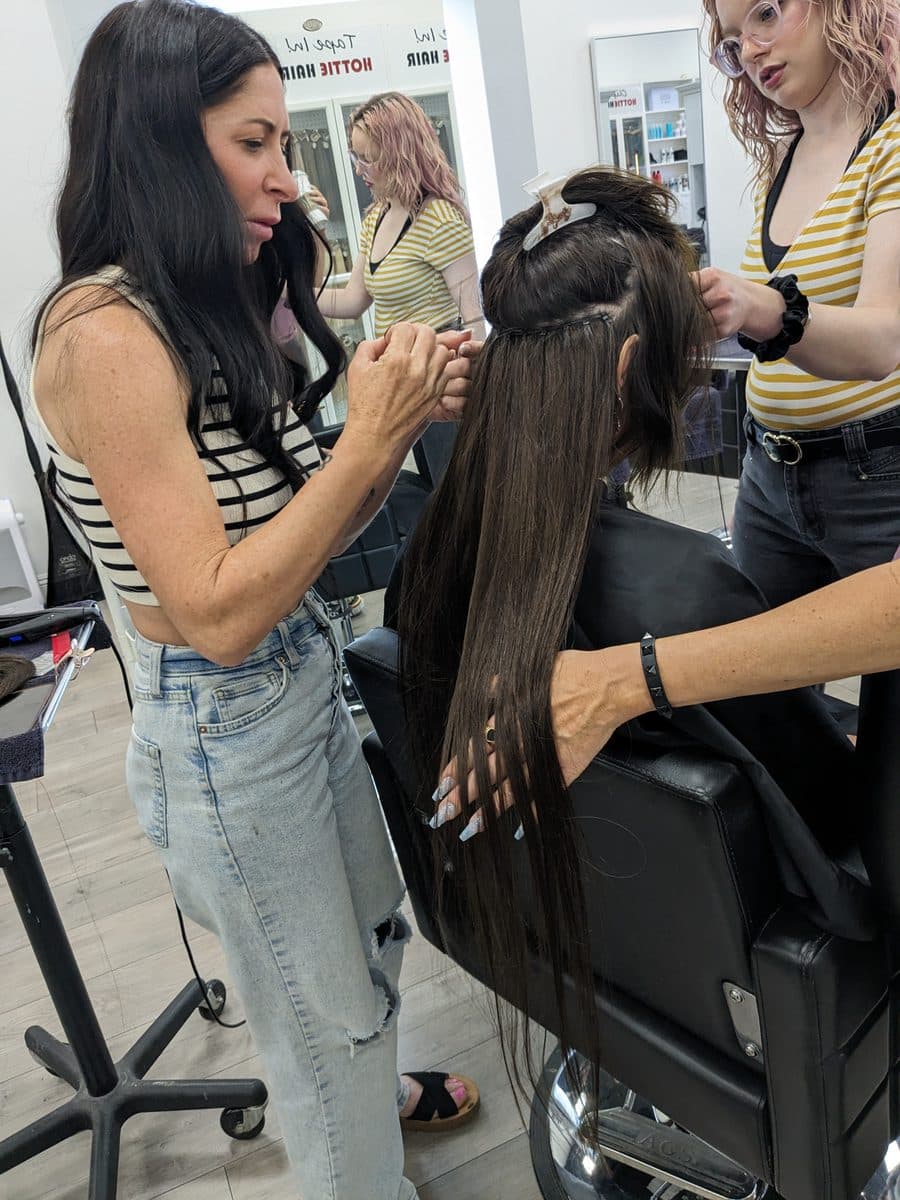
A weft install in progress — our team approach often puts two stylists on one install, which is why appointments move fast.
The 30-Second Answer
- How it works: a beaded foundation row goes onto your natural hair; the weft attaches to that row — no glue, heat, or chemicals.
- Three methods: beaded weft (machine weft, $105/row install), hand-tied weft (slimmer hand-sewn wefts, $165/row install), and sew-in variations.
- Time: ~45 minutes for one row to ~3 hours for a full multi-row install.
- Maintenance: move-up every 6–10 weeks as your hair grows; the same hair is reused for months.
- DIY? Honestly: no. Row placement and tension are exactly the two things that go wrong without training — and they're the two things that protect your natural hair.
- See it for yourself: book a free consultation or call/text (702) 979-4468.
In This Guide
What a Weft Actually Is
A weft is a curtain of hair — dozens of strands bound together along a top seam. Instead of attaching hair strand by strand (like K-tip or I-tip), weft methods attach a whole panel of hair at once along a horizontal row. That's why wefts are the go-to for volume: you add a lot of hair quickly, it lies flat against the head, and the weight is distributed along the entire row rather than hanging from individual strands.
The two weft types you'll hear about: machine wefts — durable, sewn by machine, slightly thicker at the seam — and hand-tied wefts — hand-sewn, dramatically thinner and more flexible, which is why they disappear so well on fine hair. Which weft, how many rows, and where the rows sit is the design work of the consultation.
Beaded vs. Hand-Tied vs. Sew-In: The Three Installs
| Method | The Weft | How It Attaches | Best For |
|---|---|---|---|
| Beaded weft | Machine weft | Attached to a beaded row | Maximum volume, durability, value |
| Hand-tied weft | Slim hand-sewn wefts, usually stacked 2+ per row | Sewn to a beaded row | Fine hair, flattest and most undetectable finish |
| Sew-in | Machine weft | Sewn to a braided or beaded foundation | Thicker, coarser textures; maximum security |
All three share the same core idea — a secure track, a curtain of hair, no adhesive or heat on your natural hair. The modern beaded-row approach (used in beaded weft and hand-tied installs) has largely replaced tight braided foundations for most textures because it's gentler, faster to install and adjust, and lies flatter. Braided sew-ins remain a great tool for the textures and lifestyles they suit best.
Not sure which weft fits your hair?
That's exactly what a free consultation settles — a specialist assesses your density and texture and recommends the method honestly.
The Installation, Step by Step
Here's what actually happens in the chair for a beaded-row weft install — the method we perform most:
- Sectioning and mapping. Your stylist parts out a clean horizontal section, placed carefully: low enough to stay invisible when you wear your hair up, high enough to support the weight comfortably, and away from your natural part and hairline.
- Building the foundation row. Small silicone-lined beads are threaded onto slim sections of your natural hair across the track and clamped flat. The silicone lining cushions your hair inside the bead — nothing is glued or fused. Bead spacing and tension are the craft here: even, secure, and comfortable.
- Attaching the weft. For a beaded weft, the machine weft is secured directly to the beaded row. For hand-tied, two or more slim wefts are stacked and sewn onto the row with thread. For a sew-in, the weft is stitched to the braided or beaded foundation.
- Blending and finishing. The extension hair is cut and blended into your natural hair — this cut-in is what makes rows disappear — then styled so you leave camera-ready.
Done well, the row lies flat, nothing pulls, and you stop feeling it within a day or two. If you want to see this visually, our beaded weft installation photo essay and hand-tied installation guide show real installs at our salons, and the gallery shows finished results.

The tools of a beaded-row install: beads, threader, and needle — no glue gun anywhere in sight.
How Long It Takes & What It Costs
Weft installs are priced per row at Hottie Hair, flat and published — the install and the hair are separate line items, so you always know exactly what you're paying for:
- Beaded weft install: $105 per row (about 45 minutes per row). A common 2–3 row install runs $210–$315 in installation.
- Hand-tied weft install: $165 per row (about 45 minutes per row) — more handwork per row, since the wefts are stacked and sewn.
- The hair: sold per pack and reused across move-ups — for example, 20" Russian Remy wefts run $400 and 24–26" run $600; how many packs you need depends on the fullness you're after.
- Time overall: one row is an easy lunch-break appointment; a full 3–4 row transformation is a 2–3 hour visit.
The complete math — hair plus install plus a year of maintenance, for every method — lives in our extension cost guide, and the pricing calculator gives you a personalized number fast.
Move-Ups: How the Install Stays Perfect
Your hair grows about half an inch a month, and the beaded row rides that growth away from your scalp. Every 6–10 weeks, the row is professionally moved back up: beads are opened, repositioned at the root, and re-secured, and the same weft goes back on. It's maintenance, not a re-purchase — quality weft hair typically survives 6–12 months of these cycles. Skipping move-ups is the one genuinely bad thing you can do to a weft install; a grown-out row puts uneven tension on your hair. Our move-up appointment guide covers what happens at these visits.
Watch a Weft Install Happen in Person
The consultation is free, the hair is in stock, and same-day installs are often possible. Call or text (702) 979-4468 or book online.
Book Your InstallThe Honest DIY Answer
A lot of people searching "how to install weft hair extensions" are really asking "can I do this myself?" Straight answer: we don't recommend it, and not for gatekeeping reasons. The two make-or-break variables in a weft install are row placement (done blind on the back of your own head) and bead tension (too tight causes breakage and pain; too loose slips and mats). Those are trained, practiced judgments — the exact things that protect your natural hair — and they're also why a professional install is comfortable enough to forget about within a day.
What we genuinely recommend for DIY: clip-in extensions — real Russian Remy hair, in and out yourself, zero risk to your natural hair. If you love the look and want it full-time, step up to a professional weft install. And if you've already got a DIY install that's matting or pulling, don't cut anything — our extension removal guide explains why professional removal saves your hair, and we fix other installs weekly.
Is a Weft Method Right for You?
Wefts shine when volume is the goal — fine or flat hair transformed into density that reads completely natural. Hand-tied is the pick for the finest hair; beaded weft is the durability-and-value pick; strand methods like K-tip still win for certain textures and very short starting lengths. The genuinely honest answer comes from a specialist looking at your hair — which is free here — and if you're comparing methods first, our method comparison guide and permanent extensions overview are the right next reads.
We install every weft method at all three Las Vegas Valley salons — West Charleston in Summerlin, South Maryland Parkway in Henderson, and Durango in the Southwest — with over $100K of weft hair in stock for in-person color matching.
Frequently Asked Questions
How are weft hair extensions installed?
A stylist creates a foundation row by threading small silicone-lined beads onto sections of your natural hair along a horizontal track, then attaches the weft to that row — secured directly (beaded weft) or sewn on with thread (hand-tied and sew-in). No glue, heat, or chemicals touch your natural hair, and the extension hair is then cut and blended in.
How long does a weft install take?
About 45 minutes per row. A single-row volume boost fits in a lunch break; a full 3–4 row transformation takes roughly 2–3 hours. Move-up appointments every 6–10 weeks take a similar per-row time.
Can I install weft extensions myself?
We don't recommend it. Row placement and bead tension are the two skills that make an install safe and invisible, and both are trained judgments performed on the back of your head. For DIY, quality clip-ins deliver the look with zero risk; save the weft for a professional install.
Do weft extensions damage your hair?
Not when installed professionally and maintained on schedule. The beaded row distributes weight along the whole track, silicone-lined beads cushion your hair, and nothing is glued or fused. Damage stories almost always trace to bad tension, wrong placement, or move-ups skipped for months.
What's the difference between beaded weft and hand-tied weft?
The weft and the attachment. Beaded weft uses a durable machine weft attached to the beaded row ($105/row install at Hottie Hair); hand-tied stacks two or more slim hand-sewn wefts and sews them to the row ($165/row) — thinner, flatter, and the most undetectable option for fine hair.
How much do weft hair extensions cost installed?
At Hottie Hair: installation is $105 per row (beaded) or $165 per row (hand-tied), and the hair runs $400–$600 per pack depending on length, reusable across move-ups. A typical full look lands in the high hundreds to low thousands all-in — the free consultation gives you an exact written quote.
How often do wefts need to be moved up?
Every 6–10 weeks. The row is repositioned at the root and the same hair is reattached — quality weft hair typically lasts 6–12 months across those cycles with good home care.
Volume You Forget Isn't Yours
Free consultation, in-stock hair, flat per-row pricing, and installs by specialists who do this every day — at three Las Vegas Valley locations.
Book a Free ConsultationOr call/text (702) 979-4468
Visiting Vegas?
See same-day extensions, color, and cut — the full salon experience before you fly home.
Related Articles
Continue reading about extensions

Discover beaded weft extensions—the damage-free, natural-looking solution for length and volume. Complete guide to installation, maintenance, and care for Nevada's desert climate from our Henderson and Summerlin specialists.
See every step of a 30-inch hand-tied weft extension installation — from consultation to final reveal. Real salon photos showing what to expect at your appointment in Las Vegas.

Follow a complete beaded weft extension appointment at our Las Vegas salon — from shampoo prep and beading to the dramatic before-and-after reveal. Real photos, real client.