Hair Toppers: The Complete Guide for Women with Thinning Hair (2026)
A hair topper adds coverage to the top of your head — part, crown, temples — and blends into your own hair. It's not a wig, and for most women with thinning on top it's the better answer. A Hottie Hair co-founder breaks down who toppers are for, weft vs. skin/mono bases, real Las Vegas pricing ($150–$1,000), professional install vs. clip-in, and why you should always try one on free before buying.

Watch: Hair Toppers, A Stylist's Complete Guide
Crystal Frehner walks through what a hair topper is, who it's for, how it's installed, and what it costs. 14:50.
Crystal "CryStyle" Frehner · Co-founder, Hottie Hair Salon Las Vegas
Jump to a section
By Crystal Frehner, Hottie Hair co-founder. Of every question we get on the phone, hair toppers are one of the most common — and one of the least understood. Women call describing thinning at the part or the crown, assuming their only options are a wig or just living with it. A topper is usually the better answer, and almost nobody knows it exists. So here's the complete guide.
A hair topper is a small piece of hair that sits on top of your head and adds coverage exactly where you need it — the part, the crown, the temples — while blending into your own hair around it. It's not a wig. It doesn't cover your whole head. It's the in-between solution most women with thinning hair don't realize they have, and for a lot of them, it's the thing that gives them their hair back without changing anything else.

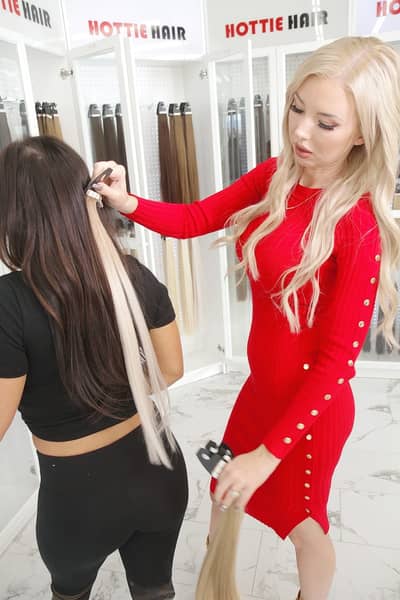
Color-matching a topper to your own hair is the whole game — it's why we have you try one on free before you decide anything.
The 30-Second Answer
- A hair topper adds coverage to the top of your head — part, crown, temples — and blends into your own hair. It is not a wig. A wig replaces all your hair; a topper supplements the hair you still have.
- It's the right call when thinning is on top but you still have healthy hair on the sides and back. That describes the majority of women with female-pattern thinning, postpartum shedding, or age-related volume loss.
- Two base types: weft (open base, breathable, more affordable) and skin/mono (looks like hair growing from scalp at the part, the most natural-looking option).
- At Hottie Hair, clip-in toppers run $150–$300 for Indian Remy and $400–$1,000 for premium Russian Remy mono-base pieces. Professional install or move-up maintenance is $200–$400.
- You can try one on free at any of our three Las Vegas Valley locations before you spend a dollar. Book a free consultation through our service builder or call (702) 979-4468.
What a Hair Topper Actually Is
A hair topper — sometimes called a hairpiece, a wiglet, or a crown piece — is a base of hair with clips (or a semi-permanent attachment) that sits on the top section of your head. It comes in different sizes depending on how much area you need to cover, and it's made from real human hair so it can be cut, colored, heat-styled, and blended to disappear into your natural hair.
The key word is blend. A topper isn't meant to be a separate thing sitting on your head. Installed and matched correctly, the hair from the topper falls and mixes with your own hair so that you — and everyone else — see one full head of hair. The piece does the heavy lifting where your hair has thinned, and your existing hair covers the edges of the piece. When it's done right, nobody can tell where one ends and the other begins.
This is fundamentally different from hair extensions, which add length and thickness to hair you already have throughout. Extensions assume you've got hair to attach to. A topper is built for the specific situation where the hair on top has gotten too sparse for extensions to help — but the sides and back are still strong.
Who Hair Toppers Are For
The women who walk out of our salon happiest with a topper almost always share one pattern: thinning concentrated on the top of the head, healthy hair everywhere else. If that's you, a topper is very likely your answer. Here's who that tends to be.

Thinning concentrated on top with healthy hair on the sides and back — the textbook situation where a topper outperforms both extensions and a wig.
Female-pattern thinning
The most common reason. For a lot of women, hair loss shows up first as a widening part and a see-through crown, while the sides and back stay full. That's the exact area a topper covers. You don't need a wig — most of your hair is fine. You need coverage in one zone, and that's what a topper delivers.
Postpartum shedding
After having a baby, a lot of women go through a heavy shed a few months in, and it frequently shows up around the hairline and temples. It usually grows back, but the in-between phase can be brutal for confidence. A smaller topper or a hairline piece bridges that gap while your own hair recovers, and then you simply stop wearing it once you've grown back in.
Age-related volume loss
Hair naturally loses density over time, and for many women that reads on the top of the head before anywhere else. A topper restores the volume that makes a hairstyle look "full" again — without committing to anything as involved as a wig, and without the daily styling battle of trying to make thin hair look thick.
Medical or treatment-related thinning
Thyroid conditions, certain medications, stress-related shedding, and other medical causes can thin the top of the head while leaving the rest. If your situation involves more widespread loss, a topper may not be enough and a wig might be the better route — which is exactly the kind of thing we figure out together at a free consultation rather than you guessing online. We'll never sell you a topper if a topper isn't the right tool.
Topper vs. Extensions vs. Wig — How to Tell Which One You Need
This is the comparison that clears up the most confusion on the phone, so here it is plainly. The deciding factor is where your hair situation is and how much coverage you actually need.
| Solution | Best for | What it does |
|---|---|---|
| Hair Topper | Thinning on top, healthy sides & back | Adds coverage to the part/crown only, blends with your hair |
| Extensions | Full but short/fine hair, want length or thickness | Adds length and volume to hair you already have throughout |
| Wig | Significant or all-over hair loss | Replaces all of your hair with a full head of new hair |
A quick gut-check: part your hair in the mirror and look at the top. If you see a lot more scalp than you used to but your ponytail still feels reasonably full, you're a topper candidate, not a wig candidate. If your hair is full everywhere and you just want it longer or thicker, you want extensions instead. We go deeper on the three-way comparison in our mesh integration vs. wigs vs. toppers guide, which is worth reading if you're weighing all of your options.

A real Hottie Hair crown-coverage transformation — thinning on top (left) to full, natural volume (right). This is exactly the situation toppers and mesh integration are built to solve.
The Two Kinds of Topper Base (This Is What Actually Matters)
When you start shopping toppers, the single most important thing to understand is the base — the part of the topper the hair is attached to, which sits against your scalp. There are two main types, and the difference is what separates a topper that looks obvious from one that's invisible.
Weft base (open, breathable, more affordable)
A weft-base topper is built on rows of hair sewn onto an open construction. It's lightweight, it breathes well — a real consideration in Las Vegas heat — and it's the more affordable option. The trade-off is that the very base of the part doesn't perfectly mimic scalp, so it relies a little more on your own hair blending over it. For most women with moderate thinning who part their hair in a consistent spot, a weft base works beautifully and is the practical choice.
Skin / mono base (looks like hair from scalp)
A skin or monofilament base is built so that each hair looks like it's growing directly out of a scalp-like surface. When you look down at the part, you see what appears to be skin and individual hairs emerging from it — not a seam. This is the most natural-looking option, especially at the part line where people's eyes go, and it's what we steer women toward when the thinning is advanced or when invisibility at the part is the top priority. It costs more because the construction is more involved and typically uses higher-grade hair.
There's no universally "right" base — it depends on how much coverage you need, where you part, your budget, and how the piece feels on you. That last part is why we don't sell toppers sight-unseen. The hair quality matters just as much as the base, and if you want the background on hair grades, our guide to virgin vs. Remy vs. non-Remy hair applies directly to toppers too.
What a Hair Topper Costs at Hottie Hair
Here's the actual menu, pulled from our current catalog. Topper pricing comes down to three things: the hair grade (Indian Remy vs. premium Russian Remy), the size of the piece (small, medium, large), and the base type (weft vs. skin/mono).
| Topper | Detail | Price |
|---|---|---|
| 12"–14" Indian Remy Clip-In Topper | Weft or skin base, small to medium | $150–$300 |
| 10"–14" Russian Remy Clip-In Topper | Premium mono base, small to medium | $400–$1,000 |
| Topper Install / Move-Up | Professional attach & maintenance (small / medium / large) | $200 / $300 / $400 |
Two ways to wear it. The simplest is clip-in — you clip the topper in yourself each morning and take it out at night, no salon visit required after the initial purchase and fitting. That's the price of the piece and nothing more. The second is a professional install, where we attach the topper more semi-permanently so it stays in for weeks at a time, then you come back for a move-up appointment ($200–$400 depending on size) to reposition it as your own hair grows. Clip-in is the easy, flexible, lower-cost route most women start with; professional install is for those who'd rather not deal with it daily.
Compared to a quality wig — which often runs well north of these numbers for human hair — and compared to the ongoing cost of hand-tied or K-tip extension maintenance, a clip-in topper is one of the most cost-effective ways to solve thinning on top. All pricing here reflects our current catalog; we'll confirm exact numbers for your specific piece and color at your consultation.
Try It On Free Before You Buy — Here's Why That Matters
Every topper and clip-in piece we carry comes with a free try-on at the salon, and I push people toward it hard, because a topper is one of those things you genuinely cannot evaluate online. Two pieces that look identical on a website can sit completely differently on your actual head. Color match, base size, how the hair falls against your own texture, whether the part lines up with where you naturally part — none of that is knowable until it's on you.

We keep a large inventory of hair in stock across colors and bases, so you can try on the real piece — not order blind and hope.
Color is the part people underestimate most. A topper that's even slightly off from your own shade announces itself in daylight. When you come in, we color-match the piece to your hair in person, and if it needs a custom color or a root tweak to disappear, our colorists handle that. This is the same reason we built our whole extension model around in-person matching rather than online ordering — you should see and feel the hair before it's yours. If you want to understand what separates a salon that does this right from one that doesn't, our guide on finding a reputable extension salon covers the red flags.
Caring for Your Topper So It Lasts
Because a topper is real human hair, it lasts a long time when you treat it well — often a year or more of regular wear, and longer if you rotate between two. The care is straightforward, and Las Vegas adds one wrinkle worth knowing about.
- Wash less than you think. Topper hair doesn't have your scalp's natural oils feeding it, so it doesn't need frequent washing. Once every 10–15 wears is plenty for most people. Over-washing is the fastest way to dry it out.
- Use sulfate-free, extension-safe products. The same rules that protect clip-in extensions apply here. Harsh shampoos strip the hair and shorten its life.
- Mind the hard water. Las Vegas water runs around 550 PPM — among the hardest in the nation — and mineral buildup dulls topper hair and can throw blonde brassy. A chelating shampoo every couple of weeks keeps it clean. Our hair porosity and Las Vegas water guide explains why this matters more here than almost anywhere else.
- Heat-style gently and store it flat or on a stand. Low to medium heat, a heat protectant, and a proper resting spot between wears keep the piece in shape and protect the base.
- Come in for a refresh when it needs one. If the color fades or the piece needs reshaping, bring it in. We can color, cut, and revive a topper the same way we would your own hair.
For the broader picture of DIY-friendly pieces — clip-in toppers alongside clip-in extensions and ponytails — our DIY styling guide walks through wearing and caring for all three.
Our Three Las Vegas Valley Locations
You can try on toppers, get color-matched, and book a free consultation at any of our three locations:
- Summerlin / West Charleston — convenient for Red Rock and the west valley
- Henderson — South Maryland Parkway, ideal for Green Valley, Seven Hills, and Anthem
- South Summerlin (Durango) — Mountains Edge and the southwest valley
West Charleston and South Maryland are open Monday through Saturday, 10 AM to 7 PM. Our Durango / Southwest location runs Tuesday through Saturday, 10 AM to 6 PM. Phone: (702) 979-4468 — call or text. Browse our clip-in hair toppers and topper services, or learn more at our hair loss education hub.
Frequently Asked Questions
What's the difference between a hair topper and a wig?
A wig replaces all of your hair with a full head of new hair. A topper only covers the top section — the part, crown, or temples — and blends into the hair you still have on the sides and back. If your thinning is concentrated on top and the rest of your hair is healthy, a topper is almost always the better, lighter, more natural-looking, and more affordable choice.
How much do hair toppers cost in Las Vegas?
At Hottie Hair, Indian Remy clip-in toppers run $150–$300 depending on size and base type, and premium Russian Remy mono-base toppers run $400–$1,000. If you want a topper professionally installed rather than worn clip-in, the install or move-up maintenance is $200–$400 by size. You can try one on free before buying, and we'll confirm exact pricing for your piece and color at your consultation.
Can I wear a topper myself, or do I need it installed?
Both options exist. Most women start with a clip-in topper they put in and take out themselves each day — no salon visit needed after the initial fitting and color match. If you'd rather not deal with it daily, we can install it semi-permanently so it stays in for weeks, then you come back for a move-up appointment to reposition it as your hair grows.
Will a hair topper look obvious or fake?
Not when it's matched and fitted correctly — that's the entire point. The two things that make a topper look natural are an accurate color match to your own hair and the right base type (a skin/mono base looks like hair growing from scalp at the part). Both are why we have you try toppers on in person and color-match them at the salon rather than ordering online. Done right, the topper blends with your hair so it reads as one full head of hair.
How long does a hair topper last?
Because it's real human hair, a well-cared-for topper typically lasts a year or more of regular wear, and longer if you rotate between two pieces. Wash it sparingly (every 10–15 wears) with sulfate-free products, use a chelating shampoo to fight Las Vegas hard-water buildup, heat-style gently, and store it flat or on a stand. Bring it in for color or reshaping whenever it needs a refresh.
Can a topper be colored and cut to match my hair?
Yes. Topper hair can be cut, colored, and heat-styled just like your own. Our colorists can custom-color a piece or add a root tweak so it disappears into your shade, and we cut and blend it into your existing hair so there's no visible line. This is part of what you get by buying from a full-service salon instead of ordering a piece online and hoping it matches.
I have postpartum hair loss — is a topper right for me?
Often, yes, as a temporary bridge. Postpartum shedding usually grows back, but the in-between months can be hard on confidence. A smaller topper or hairline piece adds coverage while your own hair recovers, and you simply stop wearing it once you've grown back in. Come in for a free consultation and we'll look at where you're thinning and whether a topper, a smaller piece, or just patience is the best plan.
Try a Topper On Free — No Pressure, No Commitment
If thinning on top has you considering a wig, come see a topper first. Free try-on and color match at all three Las Vegas Valley locations. We'll only recommend one if it's genuinely the right fit for your hair.
3 locations: West Charleston (Summerlin) | South Maryland (Henderson) | Durango (South Summerlin)
Book a Free ConsultationVisiting Vegas?
See same-day extensions, color, and cut — the full salon experience before you fly home.
Related Articles
Continue reading about extensions

Mesh integration, wigs, and hair toppers each solve hair loss differently. This side-by-side comparison covers coverage, cost, lifestyle fit, Las Vegas climate considerations, and how to decide which solution is right for you.

A mesh integration hair system fits a breathable mesh foundation over thinning areas, integrates your own hair through it, and permanently attaches an install-grade human hair topper — worn 24/7 and maintained every 6–8 weeks. Real published pricing (about $750–$1,750 complete), candidacy, and the one mistake to avoid before buying anything online.
The smart way to buy extension hair: in person, where you can color-match against your own hair, feel the quality, and try on free before paying. What's in stock at our three Las Vegas stores with real prices — clip-ins $350, ponytails $99.99, toppers from $150 — and when buying online actually makes sense.